
 &
& 


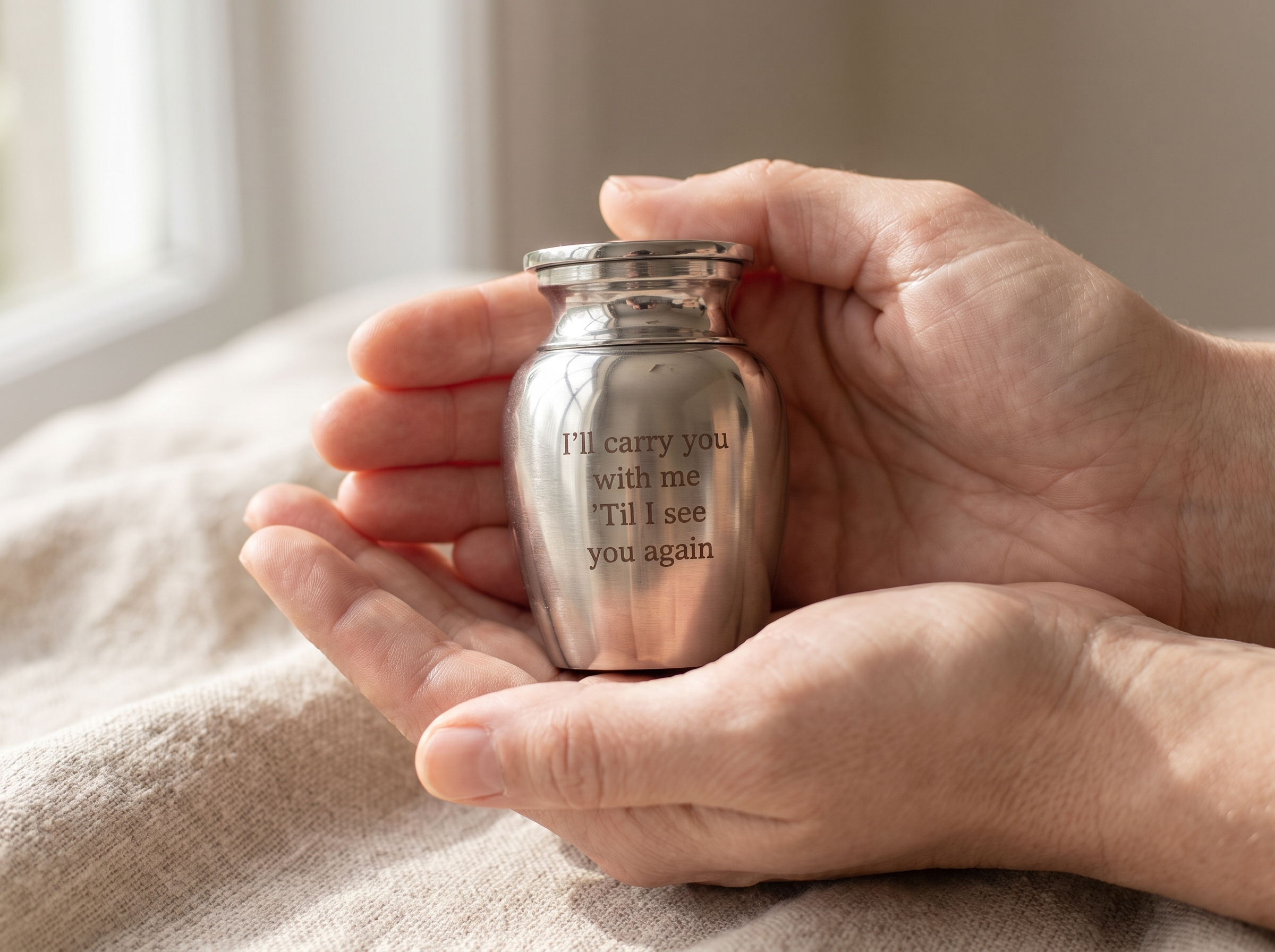
A small urn for ashes, also called a keepsake urn or mini urn, holds a portion of a loved one's ashes rather than all of them, which is what lets one family keep several. Most keepsake urns hold somewhere between one and three cubic inches, enough for a meaningful share while the main portion stays in a full-size urn, is buried, or is scattered somewhere that mattered to them.
That is the practical answer. The real reason families choose them is quieter. Nobody wants to be the one who drives home from the funeral with nothing in their hands. A small urn means Mum sits on the shelf in three houses at once, and every one of those houses is the right one.
What is a keepsake urn, and how is it different from a full-size urn?
A full-size adult urn has to hold everything. Cremated remains from an average adult come to roughly three to three and a half litres, so a full urn is a substantial object built for a mantel, a niche or a burial plot. A keepsake urn is not trying to do that job at all. It holds a share, and it is sized to sit on a bedside table, in a bookcase, or in the palm of a hand.
Once you see them side by side, the choice gets easier:
- Full-size urn. Holds the complete portion. One per family, usually kept, buried or interred.
- Keepsake or mini urn. Holds roughly one to three cubic inches. Designed to be shared out, one to each person who wants one.
- Ashes jewellery. Holds a pinch, usually under a quarter of a teaspoon. Worn rather than displayed.
- Scattering urn. Built to open easily outdoors and is not intended to be kept afterwards.
Plenty of families end up with a mix. One main urn, a Mini Personalised Keepsake Urn for each adult child, and a pendant for the grandchild who is too young for a shelf but old enough to want something.
What size small urn do you actually need?
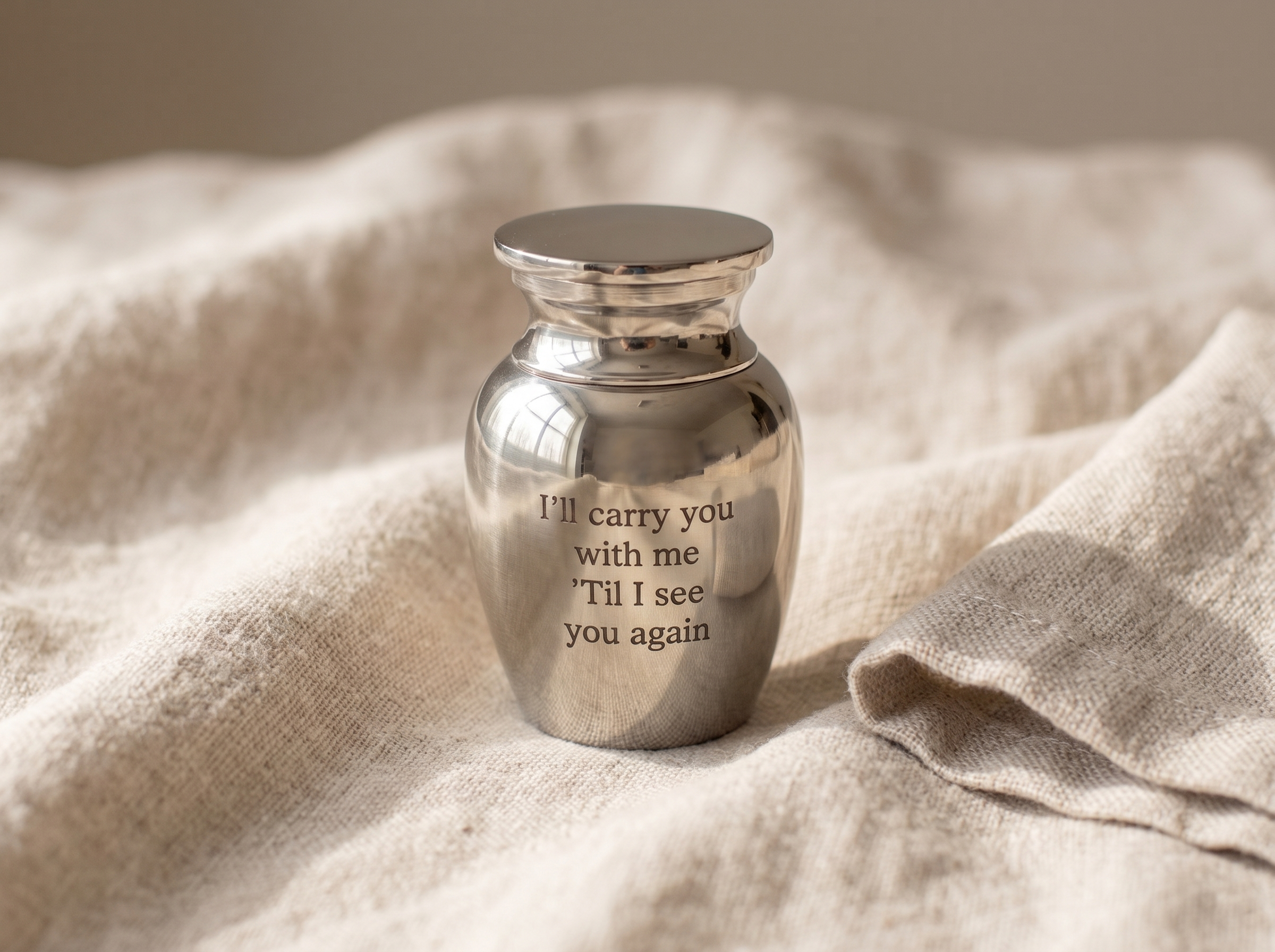
Work backwards from the decision you have already made. If the main portion is being buried or scattered, the keepsake only needs to hold what you want to keep permanently, and that is almost always less than people first assume. Families who ask for the biggest keepsake available often tell us later they would have been just as content with a smaller one.
A useful test: hold your hand out and imagine what you would want to be holding in five years, on a quiet Tuesday, when the grief has softened into something you can carry. It is rarely a large object. It is usually something small enough to close your fingers around.
If more than one person wants a share, divide the number of people into the portion you are keeping before you choose sizes, not after. Ashes cannot be added back once they have been separated.
Should a keepsake urn be engraved?
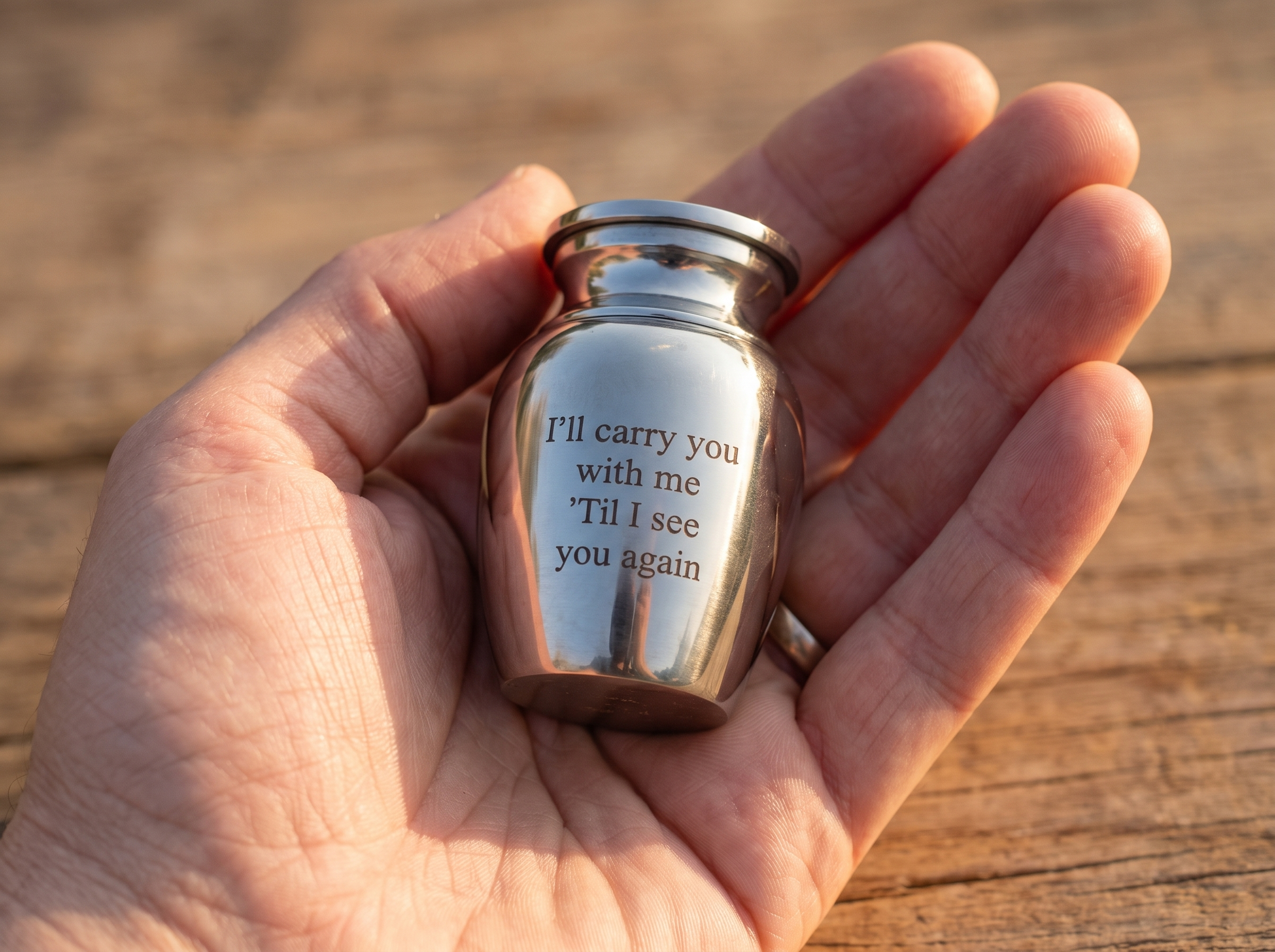
Engraving is the difference between an object and a person. An unmarked urn becomes a thing that needs explaining to visitors. A name, two dates, or three words in their own handwriting turns it into an introduction.
The engravings families ask for most are simply the name they actually used out loud. Not the full name from the death certificate, but Pop, Nan, Dad, or the nickname only the family knew. If there is a phrase they said constantly, that works even better, because you will hear it every time you walk past.
Belle Fever engraves keepsakes in Monel Silver, Moneil Gold and Moneil Rose Gold tones, so a set shared between siblings can match or deliberately differ, depending on whether the family wants them to look like a matching set or like individual pieces.
Who in the family should get one?
The honest answer is everyone who asks, and often one person who does not. Grief is not distributed evenly and it is rarely distributed loudly. The quiet in-law, the estranged sibling who came back for the funeral, the best friend of forty years who is not technically family: these are the people most likely to go without, and most likely to still be thinking about it years later.
A short list worth writing down before you order:
- Each child, including step-children, whether or not they have asked.
- The surviving partner, who may want something separate from the main urn.
- Grandchildren old enough to understand, which is often younger than adults expect.
- A lifelong friend or carer who was there for the last stretch.
- Anyone overseas who could not make it to the service.
For people who would rather wear a share than shelve it, a Heart Cremation Necklace or a Memory Cremation Necklace does the same work in a form that goes to work with them.
Is it legal to keep ashes at home in Australia?
Yes. No federal or state law in Australia prevents a family from keeping cremated ashes in a private home, and there is no requirement to register, declare or licence them. Once the crematorium has released the ashes to the person who arranged the cremation, what happens next is a family decision rather than a legal process.
Dividing them is equally unregulated. Ashes can be separated at any point after the cremation, whether that is on the day or two years later when the family has finally agreed. Many crematoriums and funeral directors will divide them for you on request, and many families do it themselves at home with a funnel and a steady bench.
How do you present a keepsake urn to someone?
Do not hand it over at the wake. Everyone is exhausted, half of them are holding a drink, and the moment gets lost. Give it later, quietly, one on one, ideally at a time when the person has somewhere to sit down.
The first Christmas and the first birthday without someone are when the absence gets loudest, and they are also when a keepsake lands hardest in the best way. A Belle Fever Luxury Gift Box makes the handover feel considered rather than clinical, which matters more than it sounds like it should.
How much ash does a small keepsake urn hold?
Most keepsake and mini urns hold roughly one to three cubic inches, which is a few tablespoons. That is a small fraction of a full adult portion of around three to three and a half litres, and it is intended as a share rather than the whole.
Can you divide ashes between several keepsake urns?
Yes. Ashes can be divided at any time after the cremation, with no permission or paperwork required once they have been returned to the family. Many funeral directors and crematoriums will divide them on request, and families can also do it themselves.
Is it legal to keep ashes at home in Australia?
Yes. There is no Australian federal or state law preventing ashes being kept in a private home, and no obligation to register or declare them.
Can a keepsake urn be engraved with a name and dates?
Yes. Belle Fever keepsakes are personalised with the name, dates or short phrase you choose, in Monel Silver, Moneil Gold or Moneil Rose Gold tones.
What if we have already scattered the ashes?
A keepsake can still hold something meaningful. Families use a lock of hair, a pinch of soil or sand from the place the ashes were scattered, or a small amount of dried flowers from the service.
Should we buy keepsake urns or ashes jewellery?
It depends on whether the person wants to display or to wear. A keepsake urn sits on a shelf and holds more. Ashes jewellery holds a pinch and travels with the person all day. Many families choose both across different members.
